
Listen Here.
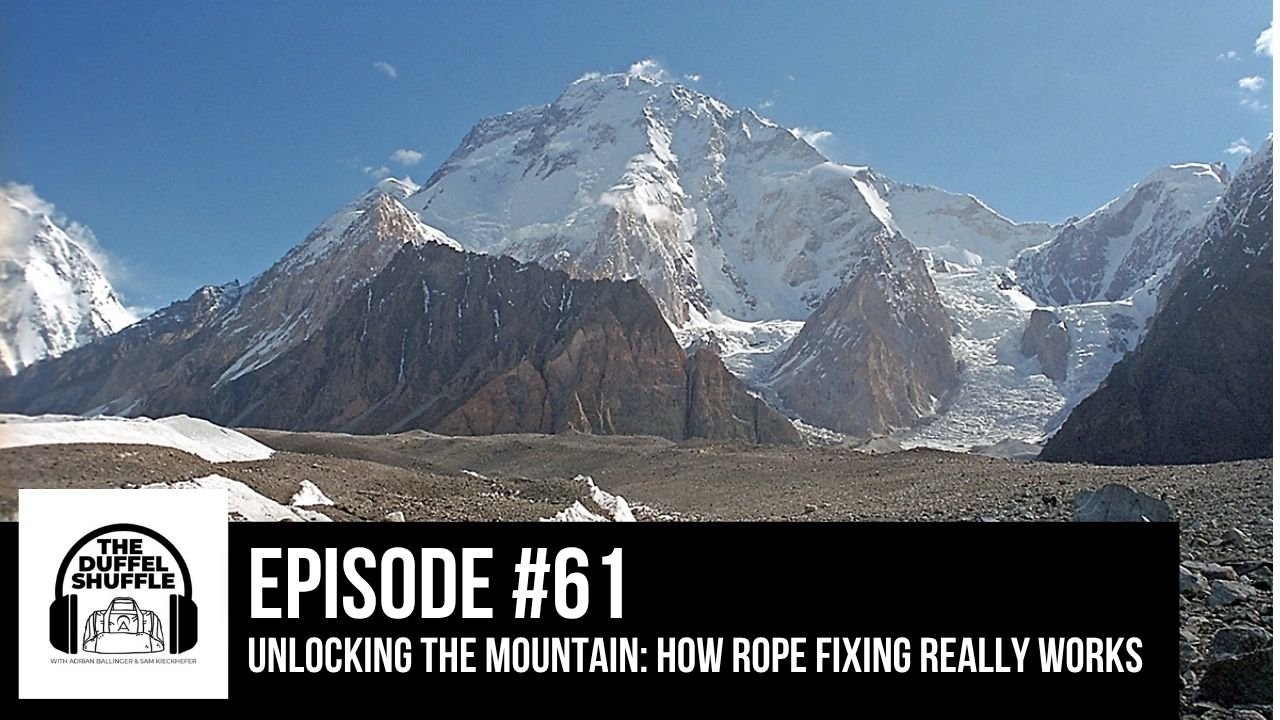
Episode 61: Unlocking the Mountain: How Rope Fixing Really Works
Episode 61 opens with a somber update on the Broad Peak avalanche in Pakistan that killed all ten climbers, including members of Nims Purja's team, on their July 30th summit push.
Following the update, Sam and Adrian dig into the episode's real focus: rope fixing, the process that makes the world's biggest mountains climbable.
Adrian breaks down the difference between alpine style — climbing a mountain in one unsupported push — and siege style, where teams fix rope from camp to camp so climbers can self-belay on the way up and move quickly on the way down. The practice exploded in scale after the 1996 Everest tragedy, when climbers caught in a whiteout couldn't find their way back to tents just yards away; today, nearly the entire route on Everest, and increasingly all 14 eight-thousanders, is strung with fixed line.
He traces how the work gets organized — from the old days of rival companies pooling gear and Sherpa labor, or tossing cash into a pot at Base Camp, to today's more formal systems: China's government-run team on Everest's north side, Nepal's Expedition Operators Association contracting the job out to local companies, and this season's milestone in Pakistan, where an all-Pakistani crew led by Mirzer Ali fixed a new line up Broad Peak's headwall — the first time a major Karakoram peak has been rope-fixed entirely by Pakistani high-altitude workers.
Adrian shares his own path into the work, from tunneling through a collapsing cornice on Ama Dablam in the early 2000s to a 2010 rope-fixing day on Everest so calm and untracked he calls it the highlight of his life. He's candid about the risks too: anchors that melt or rip out, old abandoned ropes that fail under body weight, and the 2010 K2 tragedy that killed nine climbers after a serac collapse wiped out the fixed line and left survivors without the gear or skills to downclimb.
His takeaway: fixed lines are an extraordinary safety tool, but never one to fully rely on without a backup plan.
Follow our podcast on Instagram @duffelshufflepodcast where you can learn more about us and our guests. Visit our website at www.duffelshufflepodcast.com and join our mailing list.
The Duffel Shuffle Podcast is supported by Alpenglow Expeditions, an internationally renowned mountain guide service based in Lake Tahoe, California. Visit https://alpenglowexpeditions.com/ or follow @alpenglowexpeditions on Instagram to learn more
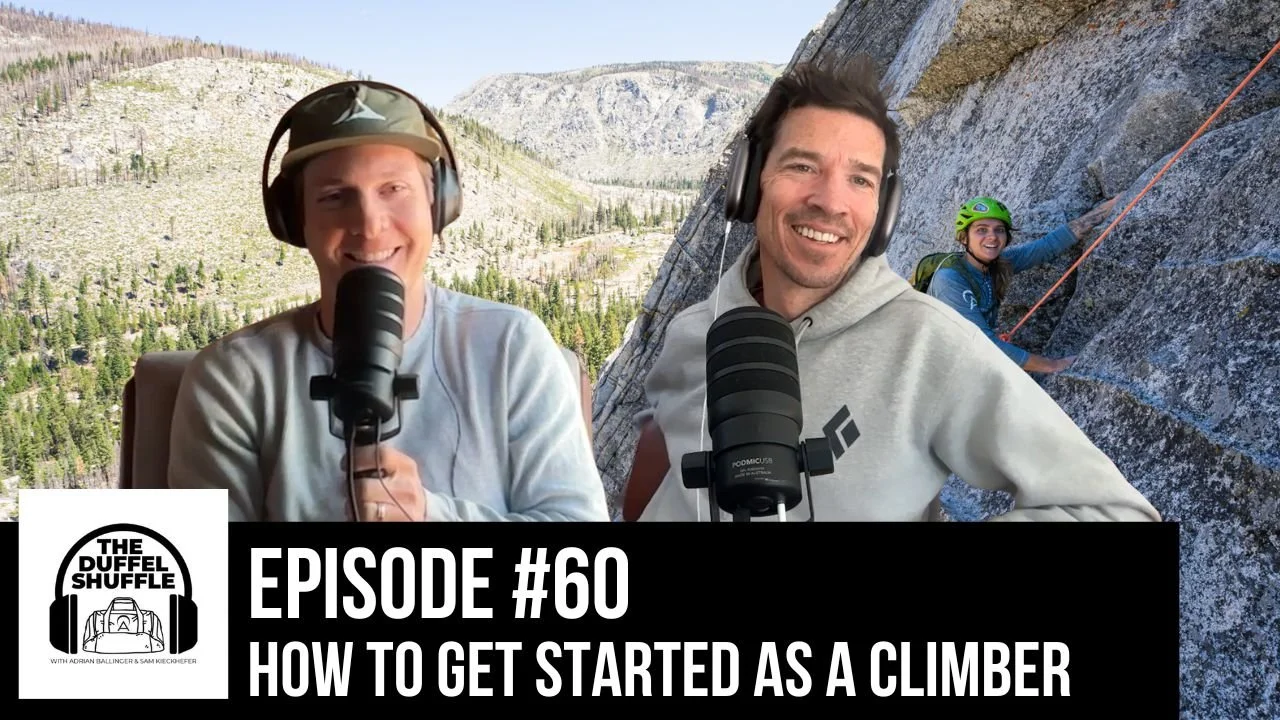
Episode 60: How to Get Started as a Climber
More than two years and sixty straight episodes for the Duffel Shuffle! Adrian calls in from a Nicaragua surf trip, and before getting into it, he and Sam touch on a rough week of accidents on classic trade routes (Mont Blanc, Huascarán, Rainier) and the FAA's new approval of drones for avalanche mitigation.
The real focus of the episode is a full roadmap for getting into climbing and mountaineering — for total beginners and for rock climbers eyeing high-altitude objectives alike. Adrian traces his own path in from age 12 on local Massachusetts crags through a college outdoor program that eventually got him to Ecuador at 17, and makes the case that adults break into the sport just as often as kids do.
Sam and Adrian lay out where to actually build the skills: climbing gyms, guide companies, and clubs for the technical basics (ropes, knots, belaying, crampon work);
via ferrata's and plain time on trails for the underrated skill of moving efficiently on uneven, exposed terrain; and a progression from guided client to genuine climbing partner, built through repeat trips with the same guide or company.
And risk — how hazard and consequence combine, why mismatched risk tolerance between partners causes the most friction in the mountains, and why so much of a guide's training is really about risk management rather than technical skill.
Parting advice: don't overthink the big goal, find your first one, and give it a few real tries before deciding it's not for you.
Follow our podcast on Instagram @duffelshufflepodcast where you can learn more about us and our guests. Visit our website at www.duffelshufflepodcast.com and join our mailing list.
The Duffel Shuffle Podcast is supported by Alpenglow Expeditions, an internationally renowned mountain guide service based in Lake Tahoe, California. Visit www.alpenglowexpeditions.com or follow @alpenglowexpeditions on Instagram to learn more.
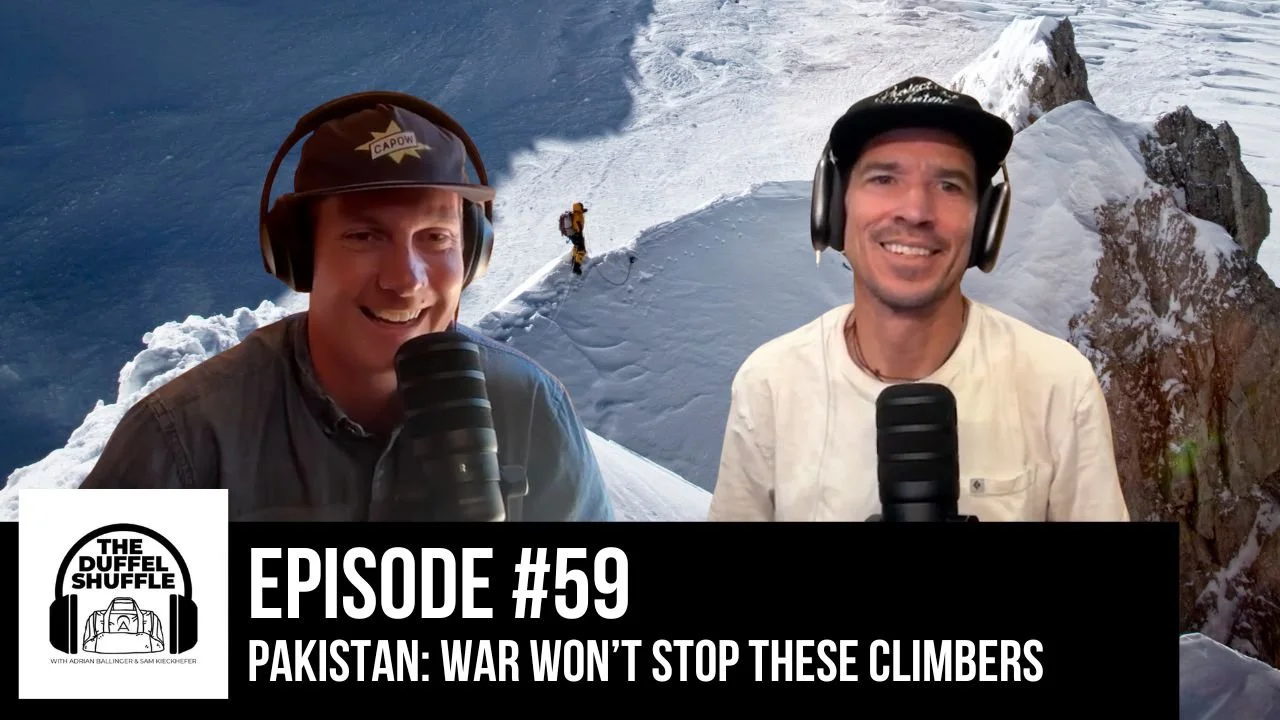
Episode 59: Pakistan Coverage - War won't stop these climbers
Sam and Adrian open episode 59 with three news stories — a bolting controversy resolved (kind of?) on Snake Dike, the public comment window on the PARC Act's draft management plans, and freeride skiing's addition to the 2030 Olympics — before shifting into a full rundown of the Pakistan 8,000-meter season, now underway.
Following spring season in the Himalaya, climbers and skiers move on to the Karakoram range, with the season often starting in June and peaking in July before temps warm too much into August.
Why Pakistan Climbs in Summer Nepal and Tibet's Himalayan season runs spring and fall because their more southern latitude brings a powerful summer monsoon that makes climbing impossible — and increasingly, makes even the shoulder seasons too warm for features like the Khumbu Icefall to hold together. Pakistan's Karakoram sits further north and west, giving it a weather pattern closer to Europe or North America, with a summer window instead. That window is compressing too: teams are now pushing to finish by mid-July rather than mid-August as glaciers destabilize earlier each year.
Nanga Parbat: A Season Already Winding Down — Except One Face Of Pakistan's five 8,000-meter peaks, Nanga Parbat climbs earliest, partly because it sits further south and is technically part of the Himalayan range rather than the Karakoram. The normal Diamir Face route is already falling out of condition. Meanwhile, a team is still attempting a new route on the Rupal Face — the mountain's massive alpine wall, home to some of the biggest lines in the world — in a pure alpine style (no camps, no fixed ropes, no pre-carrying gear).
A Quieter Pakistan Season: War and Infrastructure This year's season is noticeably smaller. Sam and Adrian point to the ongoing conflict along the Pakistan-Afghanistan border, which escalated sharply in February and forced expedition companies — including Alpenglow, along with Furtenbach Adventures and Madison Mountaineering — to sit the season out on safety and logistics grounds, while some Nepali operators chose to run smaller trips anyway. Beyond the war, Adrian frames Pakistan as roughly 20 years behind Nepal on tourism infrastructure: more avalanche exposure on routes like Broad Peak, and far less-developed logistics, hygiene, and food quality at base camp. He argues that gap will close, and that the Baltoro trek and Pakistan's climbing and skiing terrain — bigger, steeper, and less crowded than Nepal's — are worth experiencing before it does.
Andrzej Bargiel's Continuous Ski Descent of Nanga Parbat Andrzej Bargiel completed the first continuous ski descent of Nanga Parbat, skiing from summit to snowline without a break — distinct from the mountain's first-ever ski descent (Hans Kammerlander, 1990s) and last year's Rupal Face descent, both of which included overnight stops partway down. Bargiel used drone-guided route-finding to link a new line through the Diamir Face's serac zones, avoiding a rocky section that has forced other skiers to remove their skis. The descent makes Nanga Parbat his eighth of fourteen 8,000-meter peaks skied without supplemental oxygen, putting him on pace toward being the first to ski all fourteen in that style.
Remembering Guillaume "Gee" Pierrel A brief check-in following the loss of ski mountaineer Gee Pierrel on K6 a couple episodes back — his teammates are down safely, though no further details on the incident have been released.
More From the Karakoram Playground A team of Italian climbers put up a new 30-plus-pitch mixed route on K7 without summiting, which Sam and Adrian frame as a legitimate new-route achievement independent of a summit push. More broadly, they note this year's smaller, less commercial Pakistan season is producing an outsized share of no-oxygen and new-route climbing — with K2's fixed ropes up to Camp 2, and Broad Peak and the Gasherbrums positioning for summit pushes as climbers stack peaks ahead of K2's mid-to-late July window.
Follow along on Instagram @duffelshufflepodcast and visit www.duffelshufflepodcast.com to join our mailing list.
The Duffel Shuffle Podcast is supported by Alpenglow Expeditions, an internationally renowned mountain guide service based in Lake Tahoe, California. Visit www.alpenglowexpeditions.com or follow @alpenglowexpeditions on Instagram.
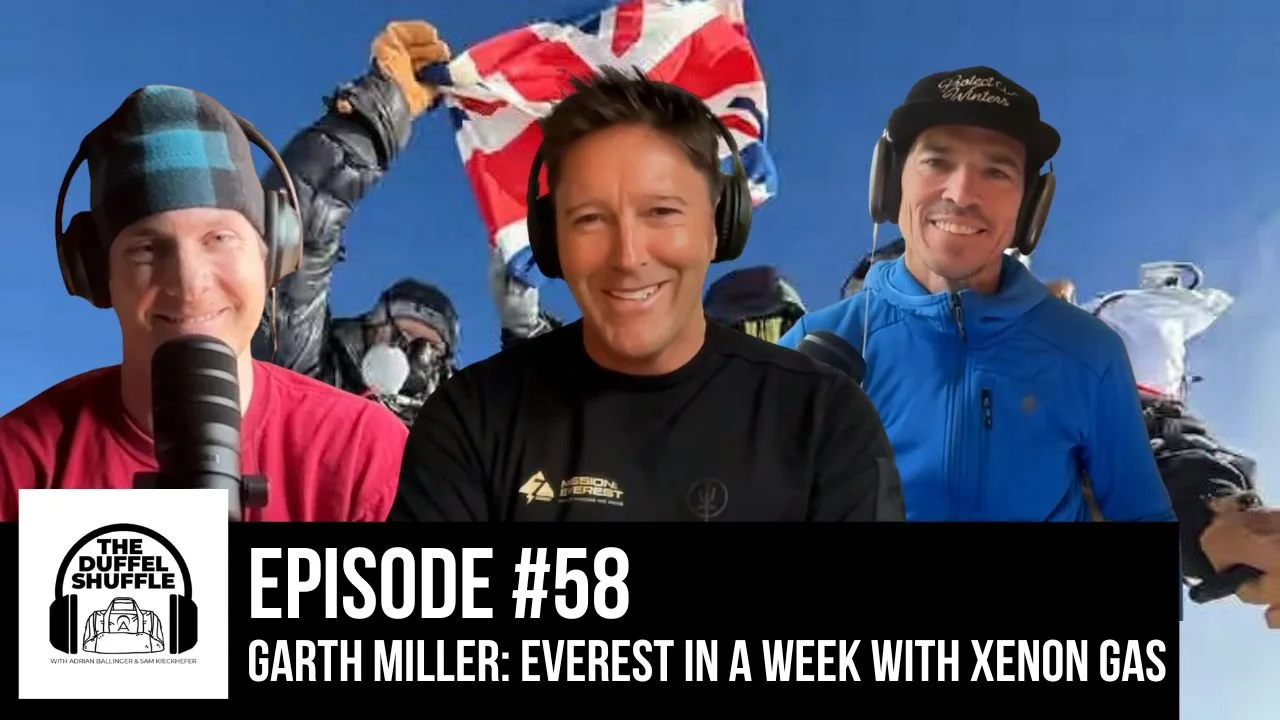
Episode 58: Everest in a Week with Xenon Gas
Episode 58 brings the Duffel Shuffle audience back to the top story from the 2025 Everest Season. While both Sam and Adrian have been skeptical of the use of Xenon Gas that made headlines last season, the two sit down with Garth Miller, a UK-based airline captain and former British Army officer.
In 2025, Garth was part of a four-person team that pulled off a London-to-London ascent of Everest in just 6.5 days, attributing their success and safety margin to the use of Xenon Gas. The conversation opened Sam and Adrian's own thinking on the substance and hearing the details behind their adventure connected some dots that had been left out in most of the media coverage surrounding their climb.
Garth first attempted Everest in 2004, turning back near the Second Step after a failed oxygen system caused repeated panic attacks. He returned in 2022, summiting Everest and Lhotse in a 21-day push
In 2025 he joined a Furtenbach Adventures expedition with three other former British special forces members, training with 550–650 hours of pre-acclimatization before a single 25-minute Xenon exposure in Germany two weeks out
The team framed Xenon as a safety tool for its neuroprotective and cardiopulmonary properties, not a performance enhancer, and pushes back on media narratives conflating it with doping
Garth points out that other altitude aids already in common use — Diamox, dexamethasone — are also WADA-banned substances, complicating the "cheating" framing Xenon received
They summited together after weathering a serious storm below the South Summit that sent much of their Sherpa team back down, and were caught in a Khumbu Icefall avalanche on the way up
Garth sees client experience-vetting, not crowding, as the bigger lever for Everest safety, and notes the team raised over $500,000 for veterans' charities including Scotty's Little Soldiers
Follow us on Instagram @duffelshufflepodcast and visit www.duffelshufflepodcast.com to join our mailing list.
The Duffel Shuffle Podcast is supported by Alpenglow Expeditions, an internationally renowned mountain guide service based in Lake Tahoe, California. Visit www.alpenglowexpeditions.com or follow @alpenglowexpeditions on Instagram.

Episode 57, Everest Coverage: Left for Dead, and Found Alive
On episode 57, Sam and Adrian dig into two stories making waves in their respective corners of the outdoor world before launching into an unplanned fifth installment of Everest season coverage and a full listener mailbag.
Sam kicks things off with a story from his own week on Mount Shasta, where he watched runner Sarah Burke blow past his group near the summit and set a new women's unsupported FKT — Horse Camp to summit in 2 hours and 10 seconds, breaking the previous mark of roughly 2:13. The moment sends him down a rabbit hole into Shasta's surprisingly deep speed-record history, from John Muir's 4:10 ascent in 1874 to Norman Clyde's 2:43 in 1923, and into a broader conversation with Adrian about what "unsupported" really means when guided teams and other climbers are nearby to help if something goes wrong.
Adrian brings his own story from Yosemite, where guidebook author Eric Sloan has added roughly 16 new bolts to the first three pitches of the famous Snake Dike route on Half Dome, shrinking runouts that once stretched 50 to 100 feet down to just 10 or 12. The move has reignited a long-simmering debate over who gets to decide how safe a historic climb should be, and both hosts land on the same conclusion: it's a conversation best settled locally, by the climbing community itself, rather than dictated from the top down.
From there, the two pivot into a story too big to leave out of the season: a fifth, unplanned Everest episode.
Hillary Dawa's Six-Day Survival on Everest — A Sherpa originally hired as a Camp Two cook for the small operator Himalayan Traverse Adventure was put on a summit push he wasn't trained or equipped for. On the descent, with the team low on oxygen and one client struggling badly, Dawa was left seated near the Yellow Band while the rest of the group continued down — and no apparent search effort followed. He spent six days descending alone, fell into a crevasse near 18,000 feet and broke his femur, survived two days trapped before an avalanche gave him a way out, and was eventually spotted crawling through the bottom of the icefall by a trash-cleanup crew before being helicoptered to safety.
What Went Wrong — and What Needs to Change — Sam and Adrian walk through the chain of decisions that led to the accident, from the irresponsibility of putting an undertrained worker on a summit push to the company's failure to search once he went missing. They push for changes that outlast this season's headlines: minimum experience standards at every level of a team, an independent rescue presence on the mountain, and government oversight enforcing basic rules at every camp.
Listener Mailbag: Suffering, Decision-Making, and the Case for a Mountain Guide — Tying directly back to the Dawa story, Adrian breaks down how to tell productive suffering from real danger at altitude, using headache severity as a rough gauge. Both hosts agree that knowing where that gray-area line sits is exactly the judgment call a certified, IFMGA/AMGA-trained mountain guide is built to make — and what was missing on Dawa's team.
Listener Mailbag: Quick Hits — Rounding out the episode: theft at high-altitude camps (rare for passports and valuables, more common as opportunistic gear grabs), training mental toughness through repeated exposure to difficulty and failure, Adrian's picks for a favorite 8,000-meter peak beyond Everest (Cho Oyu for safety and beauty, Makalu for those chasing something wilder), techniques for safely passing on crowded fixed lines, preventing snow blindness through consistent eye protection, and a candid rundown of how mountaineers manage GI distress at altitude.
With Everest properly wrapped, Sam and Adrian are turning toward guest episodes and the approaching Karakoram season, with K2 and the rest of Pakistan's big peaks on deck.
Follow us on Instagram @duffelshufflepodcast and visit www.duffelshufflepodcast.com to join our mailing list.
The Duffel Shuffle Podcast is supported by Alpenglow Expeditions, an internationally renowned mountain guide service based in Lake Tahoe, California. Visit www.alpenglowexpeditions.com or follow @alpenglowexpeditions on Instagram.
Episode 56: Was this season on Everest a smashing success?
With the 2026 Everest season now officially in the books, Sam and Adrian are back for their fourth and final installment of Everest coverage, with Adrian calling in from Denver where the season's biggest stories have been the talk of the festival floor.
Before diving into Everest, Sam and Adrian each share a news story from the week. Adrian touches on the trending trademark lawsuit between outdoor apparel giant Patagonia and Pattie Gonia, the drag persona of environmental activist and outdoor influencer Wyn Wiley, unpacking the nuance on both sides and why two brands with nearly identical values find themselves here. Sam flags two recent search and rescue incidents in the South Lake Tahoe area, which leads to a spirited debate on satellite communicators vs. iPhone satellite messaging — both landing on the same conclusion: redundancy wins.
From there, Sam and Adrian cover the following from the 2026 Everest season:
- Bartek Ziemski: Story of the Season: No contest for Adrian. The Polish ski mountaineer — a software engineer with no social media — skied Lhotse without oxygen, rested briefly, then summited and skied Everest without oxygen as well, keeping his skis on from top to bottom. Adrian reflects on what it takes physically and mentally to turn around for a second no-oxygen 8,000-meter peak in a single season, and what Bartek's ascents mean for the next generation of Himalayan ski mountaineering.
- The Season by the Numbers: A record number of climbers, a record single-day summit of 274 people, roughly five fatalities — and what may be the best no-oxygen season on record with four successful ascents including Bartek, Kristen Harila, and Nirmal Purja. Garrett Madison notched his 16th summit, Kenton Cool his 21st, and Kami Rita Sherpa extended his record to 32.
- Aviation: The Season's Most Complicated Story: Drones moving thousands of kilograms of equipment over the Khumbu Icefall represent real progress toward reducing worker trips through the mountain's most dangerous section. But widespread abuse of the helicopter rescue system — with climbers faking medical emergencies to skip the descent — is a growing problem, and Adrian argues the current regulatory framework is failing.
- Three Climbers Stranded Above the Icefall: As of recording, two Americans and a Sherpa remain at Camp 2 after the icefall was decommissioned, waiting on a helicopter that weather has so far prevented from reaching them. Adrian weighs in on the decision-making that put them there — and what it says about following the rules of the mountain you're on.
- The FKT Question — Karl Egloff and Tyler Andrews: Karl turned around below Camp 4, staying true to his no-oxygen-only philosophy. Tyler eventually summited with oxygen in just under 10 hours. Adrian congratulates Tyler on seeing the full mountain but is direct: oxygen FKTs and no-oxygen FKTs are not the same record, and keeping that distinction clear matters for the athletes still chasing the real one.
One more episode is coming. Send your Everest questions via DM, YouTube comments, or the website — Sam and Adrian are planning a bonus listener Q&A before moving on to K2 season.
Follow our podcast on Instagram @duffelshufflepodcast where you can learn more about us and our guests. Visit our website at www.duffelshufflepodcast.com and join our mailing list.
The Duffel Shuffle Podcast is supported by Alpenglow Expeditions, an internationally renowned mountain guide service based in Lake Tahoe, California. Visit www.alpenglowexpeditions.com or follow @alpenglowexpeditions on Instagram to learn more.
Episode 55: Everest Coverage - Summits begin, will chaos ensue?
With the 2026 Everest season hitting its most critical stretch, Sam and Adrian are back for their third installment of armchair mountaineering coverage.
Before diving into Everest, Adrian recommends HBO's four-part series The Dark Wizard on the life of Dean Potter, which has now released all episodes and has been making the rounds well beyond the climbing community. Adrian reflects on his feeling genuinely moved by how elegantly the filmmakers handled the full arc of Dean's life, his struggles, and ultimately his death. Sam touches on a new GPS-based avalanche transceiver from German company Nivia Safety, claiming to speed up burial searches by up to 30% and set to launch in fall 2026.
From there, Sam and Adrian cover the following from the 2026 Everest season:
Bartek Ziemski on Lhotse: The Polish ski mountaineer made only the second ski descent of the Lhotse Couloir — the first without oxygen, without new fixed ropes above Camp 3, and without ever taking his skis off, including finding a creative line through the icefall. Adrian, who made the first ski descent of Makalu and has a personal connection to Bartek, calls it one of the most groundbreaking Himalayan ski mountaineering achievements he's seen. Since recording this episode, Bartek went on to successfully summit and ski Everest without oxygen as well.
The First Summit Wave: The rope fixing team reached the summit and six clients followed before the weather window closed. Adrian celebrates the fixing effort while pushing back on the practice of clients climbing on rope fixing day — a habit that adds pressure to the team doing the most dangerous work on the mountain.
Summit Windows and Crowd Management: With a record number of climbers on the south side and a compressed season, Adrian breaks down what the next 10 days look like, how teams are positioning themselves across two potential windows, and why he's always preferred a marginal weather day with fewer people over a perfect day with 150 climbers on the route.
Speed Ascents, Kristen Harila, and No-Oxygen Attempts: A look at the notable storylines shaping up for the final push — including Tyler Andrews and Karl Egloff's contrasting acclimatization approaches ahead of their FKT attempts, and Kristen Harila's no-oxygen bid after summiting Nuptse without supplemental oxygen as a warmup.
Follow our podcast on Instagram @duffelshufflepodcast where you can learn more about us and our guests. Visit our website at www.duffelshufflepodcast.com and join our mailing list. The Duffel Shuffle Podcast is supported by Alpenglow Expeditions, an internationally renowned mountain guide service based in Lake Tahoe, California. Visit www.alpenglowexpeditions.com or follow @alpenglowexpeditions on Instagram to learn more.

Episode 54: Everest Coverage - Onward and Upward Despite Real Hazards
With the 2026 Everest season now firmly underway and the icefall finally open, Sam and Adrian are back for their second installment of armchair mountaineering coverage.
Sam opens with a somber news section, paying tribute to two losses that hit close to home in the outdoor community: Bernie Rosow of Mammoth and Will Stanhope of BC, killed in separate incidents within days of each other. Adrian knew both casually, and reflects on what made each of them so magnetic — Bernie grinding away as a snow cat driver while somehow getting out more than anyone on the east side of the Sierra, and Will quietly pushing the cutting edge of hard trad lines in Squamish and around the world for decades. Adrian also brings a lighter story out of the Himalaya: a Russian and Ukrainian climber who headed to Manaslu in the spring off-season, found the mountain entirely to themselves, and hung it way out there in proper old-school style — a good reminder that the vast majority of the world's mountains can still deliver wild experiences.
From there, Sam and Adrian dig into the following topics from the 2026 Everest season:
- The Icefall Opens: The threatening serac that delayed the season has partially fallen, a route has been threaded, and teams are moving — but the season is now running in the most compressed window of the modern era, with record permit numbers and a shortened timeline creating real human factors pressure.
- Drones on Everest: Last season's successful drone trials have hit a regulatory pause, and Adrian unpacks why that's both completely predictable and genuinely frustrating — and why getting drones properly established on the mountain may be the single most important step toward making the south side safe enough for Alpenglow to return.
- Topo's First Impressions and Season Conditions: Alpenglow guide Topo Mena has made his first carry to Camp Two on the south side with early reports positive. Adrian also notes the mountain is running unusually dry this season, which exposes hard ice on the Lhotse Face and adds challenge for everyone — including speed climbers Tyler Andrews and Karl Egloff, who are on the mountain chasing records.
- Listener Question — Does the Round Trip Count?: A listener asks the guys to weigh in on whether a summit counts if you don't make it back under your own power. Sam and Adrian don't hold back.
Follow our podcast on Instagram @duffelshufflepodcast where you can learn more about us and our guests. Visit our website at www.duffelshufflepodcast.com and join our mailing list. The Duffel Shuffle Podcast is supported by Alpenglow Expeditions, an internationally renowned mountain guide service based in Lake Tahoe, California. Visit www.alpenglowexpeditions.com or follow @alpenglowexpeditions on Instagram to learn more.
Episode 53: Everest Coverage: Icefall Holdup and South Side Action
With the 2026 Everest season officially underway, Sam and Adrian kick off what will be four consecutive episodes of armchair mountaineering — a first for Adrian, who for most of the last two decades has been on the mountain rather than watching from home. It's a unique vantage point, and one he's leaning into fully.
Before diving into Everest, the guys pay tribute to Jim Whittaker, the first American to summit Everest in 1963, whose passing was announced recently at the age of 97. Adrian reflects on Whittaker's outsized influence on American mountain guiding culture — from his early days at REI to his brother Lou's founding of RMI, the institution that shaped a generation of guides and guide companies across the country. Sam also circles back on a story that slipped through the cracks last episode: Cody Townsend and Tommy Caldwell's first ski-climb winter traverse of Norman's 13 in the Eastern Sierra — an eight-day, 40,000-foot suffer fest that Adrian and Sam dig into with obvious admiration.
From there, Sam and Adrian cover the following topics from the opening weeks of the 2026 Everest season:
Early Summits on Annapurna, Dhaulagiri, and Makalu: What's driving the trend of climbers targeting multiple 8,000-meter peaks in a single season, and what the logistical and safety implications of that strategy actually look like on the ground.
Khumbu Icefall Delays: A threatening serac has delayed route fixing through the icefall, pushing the season's timeline later than ideal. Adrian provides important context on where the serac likely is, why the media narrative may be off, and what the icefall doctors' cautious approach actually signals.
Topo Mena on the South Side: Alpenglow guide Topo Mena is heading to Everest's south side with a small, fast team through Pemba Gelje's Expeditions High Mountain — and Adrian explains why this trip is as much an information-gathering mission for Alpenglow's future south side decision-making as it is a personal guiding trip for Topo and Carla.
Ryan Mitchell and the Oxygen Debate: A Minecraft-turned-mountaineer's medical emergency at base camp sparks a broader conversation about what it actually means to climb Everest without supplemental oxygen, where the line is, and how oxygen compares to other forms of aid on the mountain.
Follow our podcast on Instagram @duffelshufflepodcast where you can learn more about us and our guests. Visit our website at www.duffelshufflepodcast.com and join our mailing list. The Duffel Shuffle Podcast is supported by Alpenglow Expeditions, an internationally renowned mountain guide service based in Lake Tahoe, California. Visit www.alpenglowexpeditions.com or follow @alpenglowexpeditions on Instagram to learn more.
Episode 52: What does it mean to be a Mountain Guide?
With a string of high-profile guiding accidents making headlines this winter — including close to home here in Tahoe — Sam and Adrian sit down to dig into what it actually means to be a mountain guide, how guide companies are held accountable, and what you, as a consumer, should be looking for before you hire someone to take you into the mountains.
Before diving in, Adrian shares a personal update: a fractured back sustained in a sport climbing fall at Starwall that has him sidelined for the spring. Ever the risk management thinker, he unpacks the decision-making lapse that led to the accident and what the takeaway actually is. Sam, freshly back from a family ski trip to Davos, also weighs in on a developing fraud story out of Nepal in which rescue companies are alleged to have poisoned clients with baking soda to trigger fraudulent helicopter rescues — and why the distinction between mountain guides and high-altitude workers matters enormously in that conversation.
From there, Sam and Adrian turn to the main event: a wide-ranging conversation on guiding, certification, and accreditation.
What Is a Mountain Guide?: Why the term is so contested in the US versus Europe, and why the semantics actually matter for clients trying to evaluate who they're hiring.
Certification: How the AMGA certification and scope of practice system works, where Sam sits in that process, and why the gold standard is both certification and experience — not one without the other.
Accreditation: What AMGA accreditation means for guide companies, why only 32 businesses in the US have achieved it, and why Adrian believes it should become the industry standard — not the exception.
The Client's Role: Why the best guided experiences are partnerships, and why showing up as an active participant — not just a passenger — matters regardless of how qualified your guide is.
Follow our podcast on Instagram @duffelshufflepodcast where you can learn more about us and our guests. Visit our website at www.duffelshufflepodcast.com and join our mailing list. The Duffel Shuffle Podcast is supported by Alpenglow Expeditions, an internationally renowned mountain guide service based in Lake Tahoe, California. Visit www.alpenglowexpeditions.com or follow @alpenglowexpeditions on Instagram to learn more.

Episode 36 - K2: The Savage Mountain
George Bell, a climber on the 1953 American Expedition to K2 said "It's a savage mountain that tries to kill you." Nearly than 75 years later, the reputation is intact. Adrian successfully climbed K2, without supplemental oxygen, in 2019, doubling down on his no o2 ascent of Everest in 2017.
With decades of experience climbing and guiding clients throughout the Himalaya, Adrian has spent little time in the Karakoram, and has only climbed K2 once. Following the 2025 K2 climbing season, Sam and Adrian connect to break down K2, and discuss Adrian's take on the mountain as well as his experience.
- Adrian shares his description of the route, starting with the trek in. Not only does he talk about some of the main features of the mountain, but he also discusses the famed objective hazards, from GI bugs to the Bottleneck Serac.
- Adrian shares a bit about why he's avoided K2 for most of his career, and how a tragic accident in 2008 took the life of a good friend, deterring him from the mountain for many years.
- Despite being supported by Topo Mena, who too has dreams of climbing K2 without oxygen, Adrian shares the one route on the mountain that he would climb, if it were possible.
Adrian's film, Breathtaking: K2 - The World's Most Dangerous Mountain, can be found on youtube.
Follow our podcast on Instagram @duffelshufflepodcast where you can learn more about us and our guests. Visit our website at www.duffelshufflepodcast.com and join our mailing list. The Duffel Shuffle Podcast is supported by Alpenglow Expeditions, an internationally renowned mountain guide service based in Lake Tahoe, California. Visit www.alpenglowexpeditions.com or follow @alpenglowexpeditions on Instagram to learn more.

Episode 33 with Billi Bierling: Mt. Everest’s Record Keeper
In such a storied climbing region like the Himalaya, recording the history of the people who have climbed there and the summits they reached is vital. In this Episode of the Duffel Shuffle Podcast, Adrian sits down with Billi Bierling, the current director of the Himalayan Database, the go-to historical database of climbing in the Himalaya, to discuss Everest, modern high altitude climbing, and the life of the Himalayan Database.
Billi is a renowned journalist, high-altitude climber, and has been the director of the Himalayan Database since 2016, taking over after its founder, Elizabeth Hawley. With ascents of major peaks including Mount Everest, Manaslu, Cho Oyu, and Lhotse — Bierling brings both credibility and firsthand experience to her work. Bierling has been instrumental in expanding the reach and accessibility of the database, ensuring it remains a vital resource for climbers, researchers, and historians alike.
- Billi and Adrian talk about the Himalayan Database and the History of Everest.
- Billi shares about her time spent in Kathmandu and her own passion for mountaineering
- Adrian and Billi chat about Everest, the ever-changing dynamics of modern high-altitude mountaineering, and climbing without oxygen.
You can learn more about the Himalayan Database at https://www.himalayandatabase.com/. And you can follow along with Billi at her website; https://billibierling.com/, or follow her on Instagram @billi_bierling.
Follow our podcast on Instagram @duffelshufflepodcast where you can learn more about us and our guests. Visit our website at www.duffelshufflepodcast.com and join our mailing list. The Duffel Shuffle Podcast is supported by Alpenglow Expeditions, an internationally renowned mountain guide service based in Lake Tahoe, California. Visit www.alpenglowexpeditions.com or follow @alpenglowexpeditions on Instagram to learn more.

Episode 32 with Mike Pond: The Life of a Mountain Guide, From the Tahoe Via to Mount Everest
In this episode of the Duffle Shuffle, we dive into the life of a mountain guide who guides everything from the Tahoe Via Ferrata in Olympic Valley, CA, to the summit of Mount Everest. Mike Pond is a career mountain guide who has spent his life climbing and guiding on mountains all over the world. At Alpenglow, he guides across the entirety of its programming, from rock climbing and the via ferrata, to high-altitude mountains in the Himalaya and beyond.
In this episode, we'll talk about balancing life as a father, husband, and mountain guide, the diversity of climbing guiding that can be done, and Mike's experience climbing on Everest.
You can follow Mike on Instagram at @mikepondclimbs. And you can check out his salve skin care product, Booboo butter, at the Alpenglow Office!
Follow our podcast on Instagram @duffelshufflepodcast where you can learn more about us and our guests. Visit our website at www.duffelshufflepodcast.com and join our mailing list. The Duffel Shuffle Podcast is supported by Alpenglow Expeditions, an internationally renowned mountain guide service based in Lake Tahoe, California. Visit www.alpenglowexpeditions.com or follow @alpenglowexpeditions on Instagram to learn more.

Episode 31: Is Xenon Gas the Future of Climbing Everest?
Following a successful Everest expedition in which Adrian successfully reached the summit for the 10th time, Sam and Adrian catch up to cover some of the notable storylines from the season.
While much of the 'action' occurs on the South side of the mountain, a route that Alpenglow does not climb, Adrian has such intimate knowledge of both sides that his perspective is unique. Additionally, between mountain guide gossip and the Sherpa grapevine, a lot if information gets passed without percolating to the mainstream media, some of which we get an inside scoop on in this episode.
Sam and Adrian talk about the following storylines from the 2025 Everest Season:
- Deaths and Rescues: While the 5 fatalities on the south side of the mountain (and zero on the North side) is a relatively low number as compared to recent seasons, rescues and near-misses reached record highs.
- Anja Blancha: One of only two successful no oxygen summits of Everest this season was achieved by the German climber, her 12th of 14 8,000ers without supplemental O2.
- FKT Attempts: Neither Karl Egloff nor Tyler Andrews were successful in reaching the summit of Everest, both of whom set out for Fastest Known Times.
- Xenon Climbers: Arguably the story of the season, Furtenbach Adventures' Flash Ascent of Everest using Xenon Gas was successful, but is Xenon really the future of climbing the tallest peaks around the world?
Follow our podcast on Instagram @duffelshufflepodcast where you can learn more about us and our guests. Visit our website at www.duffelshufflepodcast.com and join our mailing list. The Duffel Shuffle Podcast is supported by Alpenglow Expeditions, an internationally renowned mountain guide service based in Lake Tahoe, California. Visit www.alpenglowexpeditions.com or follow @alpenglowexpeditions on Instagram to learn more.

Episode 30 with Topo Mena: Catching Up on Everest from Base Camp
Adrian Ballinger and the Alpenglow Expedition team had success on Everest! First, Sam and Adrian had a chance to catch up briefly following Adrian's 10th summit of the tallest mountain in the world. In this episode of The Duffel Shuffle, the two touch base with Esteban "Topo" Mena, Alpenglow's co-expedition leader, from base camp on the North Side of Mount Everest before Alpenglow's summit push.
Topo Mena is an IFMGA guide, Black Diamond Athlete and an inspiration to many. Topo’s accomplishments include many summits of 8,000m peaks, including multiple on Everest as well as K2, Gasherbrum I, Gasherbrum II, Cho Oyu, Makalu, and Manaslu, as well as more than 250 summits of Cotopaxi in his home country of Ecuador. Topo has participated in grade VI first ascents in the Himalayas and in the Tien Shan, unsupported ascents without supplementary oxygen of 8000m peaks (including Mount Everest in 2013 at age 23 during his first expedition to the mountain), and numerous ascents pursuing difficulty or speed in his beloved Andes, or in the Himalayas, Karakorum, Alps, Tien Shan, Pamirs and Antarctica.
Following up on Episode 2 of the Duffel Shuffle, Sam and Adrian check back with Topo to hear about his recovery, and how he perceives his return to "100%".
- Topo talks about his role as Co-Expedition Leader alongside Adrian with Alpenglow Expeditions' Everest Team.
- Topo shares a bit about the importance of a strong team on Everest, and how being co-expedition leader alongside such a strong team of guides makes the role easy.
- Topo talks about his personal climbing goals, and his continued focus on opening a new route on Mt Everest.
You can learn more about Topo on Instagram, @estebantopomena, and through his sponsor https://blackdiamondequipment.com/blogs/athletes/esteban-topo-mena.
Follow our podcast on Instagram @duffelshufflepodcast where you can learn more about us and our guests. Visit our website at www.duffelshufflepodcast.com and join our mailing list. The Duffel Shuffle Podcast is supported by Alpenglow Expeditions, an internationally renowned mountain guide service based in Lake Tahoe, California. Visit www.alpenglowexpeditions.com or follow @alpenglowexpeditions on Instagram to learn more.

Episode 29: Ask Adrian Anything—Live from Everest Base Camp
Adrian Ballinger is joining us live from base camp on the North Side of Mount Everest. We've collected more than 30 questions from you, the audience, over the past months, and now it is time to rapid fire answer as many as we can.
With questions all across the board, we cover the following topics:
- Everest costs, financial requirements and alternatives
- Training and physical preparation for Everest and other climbing goals
- How to progress as a climber, and comparing different training grounds
- Mentorship and how to develop your personal climbing mindset
- Routes, risk and other strategies
- Acclimatization and other health factors
- Equipment, food and staying comfortable
- Sustainability and ethics
A huge thank you to those who submitted questions. We're stoked to interact with our audience, and ensure the content we're putting out is of interest to you! If you have further questions, DM us on Instagram, comment on our posts, or leave us a message on our YouTube episodes; we love hearing from you!
Follow our podcast on Instagram @duffelshufflepodcast where you can learn more about us and our guests. Visit our website at www.duffelshufflepodcast.com and join our mailing list. The Duffel Shuffle Podcast is supported by Alpenglow Expeditions, an internationally renowned mountain guide service based in Lake Tahoe, California. Visit www.alpenglowexpeditions.com or follow @alpenglowexpeditions on Instagram to learn more.

Episode 28 with Melissa Arnot Reid: More Than Just an Everest Guide
Melissa Arnot Reid is not only a mountain guide, speaker and author, but she's also an athlete. Melissa is the first American woman to successfully summit and descend Mount Everest without supplemental oxygen, a peak she has climbed a total of 6 times throughout her career.
Melissa's new book, Enough: Climbing Toward a True Self on Mount Everest, released on April 1, and we had a chance to connect with her following the launch to learn more.
- The three kick off their conversation with a bit of talk about running and Melissa's current running endeavors.
- Melissa shares a bit about her book, the process of writing, the importance in her own healing journey, and the origins of the title Enough.
- Melissa dives into her mountain experiences as a child, how she found her way into guiding through RMI, and some of the challenges of being a women in a predominantly male industry.
- Melissa catches us up on life today, and raising two kids by two working mountain guide parents.
You can learn more about Melissa on Instagram, @melissaarnot, and through her website www.melissaarnot.com/. Melissa's new book, Enough: Climbing Toward a True Self on Mount Everest, can be found wherever you buy your books, including on Amazon.
Follow our podcast on Instagram @duffelshufflepodcast where you can learn more about us and our guests. Visit our website at www.duffelshufflepodcast.com and join our mailing list. The Duffel Shuffle Podcast is supported by Alpenglow Expeditions, an internationally renowned mountain guide service based in Lake Tahoe, California. Visit www.alpenglowexpeditions.com or follow @alpenglowexpeditions on Instagram to learn more.

Episode 26 with Garrett Madison: A Life of Expeditions, From Everest to K2
Garrett Madison is considered to be one of America's premier Everest guides. In addition to leading nearly 100 clients to the summit of Mt. Everest, Garrett has made a lasting impact on the world of expedition climbing in the Himalaya and Karakoram, with notable firsts including the first guided climbs of K2 and guided linkups of Everest and Lhotse.
Prior to departing for the 2025 Everest season, Garrett joined Sam and Adrian on episode 26 of the Duffel Shuffle Podcast. Garrett shares his journey to becoming a guide, and the incredible opportunities he's had throughout his career.
- Garrett's initial interest in becoming a guide started on Mt. Rainier, where he got his start in the profession through hundreds of ascents in his early years as a guide.
- Garrett shares his experience with guide certification, and how his career has followed a path in which formal training/certification has not been necessary.
- Garrett talks about what he's seen change in the industry, and how he's focused on mitigating the negative impacts around the increase in number of climbers each season.
You can learn more about Garrett on Instagram, @garrettmadison1 and through his business, Madison Mountaineering, on Instagram @madisonmtng and online at www.madisonmountaineering.com. To learn more about his foundation, visit www.madisonmountaineering.com/foundation.
Follow our podcast on Instagram @duffelshufflepodcast where you can learn more about us and our guests. Visit our website at www.duffelshufflepodcast.com and join our mailing list. The Duffel Shuffle Podcast is supported by Alpenglow Expeditions, an internationally renowned mountain guide service based in Lake Tahoe, California. Visit www.alpenglowexpeditions.com or follow @alpenglowexpeditions on Instagram to learn more.
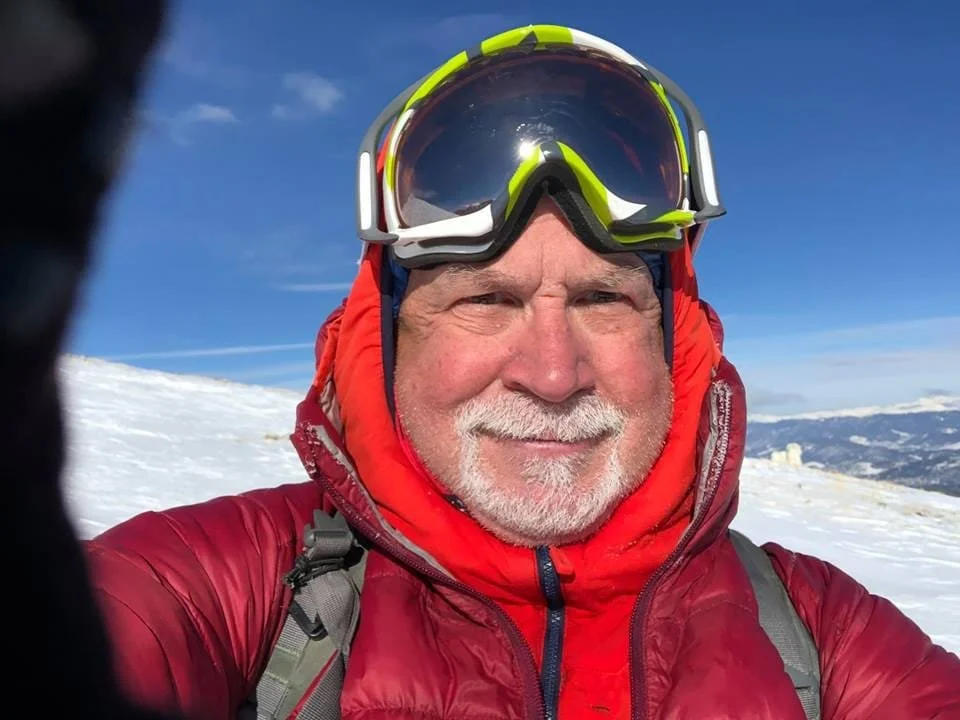
Episode 25 with Alan Arnette: The Everest Chronicler
Referred to by Outside Magazine as "one of the world's most respected chroniclers of Everest," Alan Arnette is not only a journalist, but also a climber. At age 38, Alan discovered a passion for climbing and completed over 37 expeditions, including Mt. Everest and K2. Living in Colorado, he has summited all 58 of the 14,000-foot mountains over 225 times.
In anticipation of the 2025 Mt Everest climbing season, Alan joins Sam and Adrian on episode 25 of the Duffel Shuffle Podcast! Alan talks about his life, entering the world of climbing and mountaineering as an adult.
- Alan shares his path to climbing, and how he shifted his life at age 38 and became quickly embedded into the world of mountaineering.
- Alan talks about some of his experiences on expeditions, including Mt Everest and K2 expeditions that were transformative in his life as a climber.
- Alan highlights the importance of having a purpose in climbing, and shares his connection to Alzheimer's advocacy after watching his mom, Ida, decline. Today, he advocates for Alzheimer's patients and caregivers through his mountain climbing.
You can learn more about Alan through his blog, https://www.alanarnette.com/ and his Instagram, @arnette.alan. Alan's coaching services can be followed at https://summitcoach.org/.
Follow our podcast on Instagram @duffelshufflepodcast where you can learn more about us and our guests. Visit our website at www.duffelshufflepodcast.com and join our mailing list. The Duffel Shuffle Podcast is supported by Alpenglow Expeditions, an internationally renowned mountain guide service based in Lake Tahoe, California. Visit www.alpenglowexpeditions.com or follow @alpenglowexpeditions on Instagram to learn more.

Episode 24: A Behind the Scenes Look at Planning Everest Expeditions
On Episode 24 of The Duffel Shuffle Podcast, Sam and Adrian dive into the nitty gritty details of what goes into planning an Everest Expedition, behind the scenes. Adrian has guided dozens of expeditions to the Himalaya, and while the industry and technology are forever changing, the process of planning a Himalayan expedition, particularly to Mt Everest, follows a fairly typically path.
- Everest planning is truly a year-round activity, but Adrian tries to protect the month of July as his "no Everest" month.
- Beginning in August, and lasting until the early part of January, Adrian is focused on building the best possible team. This often starts with clients, but by the permit deadline he has his clients, guides and sherpa team established.
- Once the CTMA (Chinese Tibetan Mountaineering Association) permit deadline comes and goes, Adrian's focus turns to equipment and travel plans. With gear cache's in Tingri, Tibet and Kathmandu Nepal, as well as the US, and other supplies coming from Europe and South America, the duffel shuffle is always extensive.
- Finally, with visa's secured, and equipment en route, Adrian and the team will begin their travels through China, into the TAR, and onto Basecamp.
You can follow Adrian's Everest season and more on Instagram @adrianballinger, and the entire team through @alpenglowexpeditions.
Follow our podcast on Instagram @duffelshufflepodcast where you can learn more about us and our guests. Visit our website at www.duffelshufflepodcast.com and join our mailing list. The Duffel Shuffle Podcast is supported by Alpenglow Expeditions, an internationally renowned mountain guide service based in Lake Tahoe, California. Visit www.alpenglowexpeditions.com or follow @alpenglowexpeditions on Instagram to learn more.