
Listen Here.
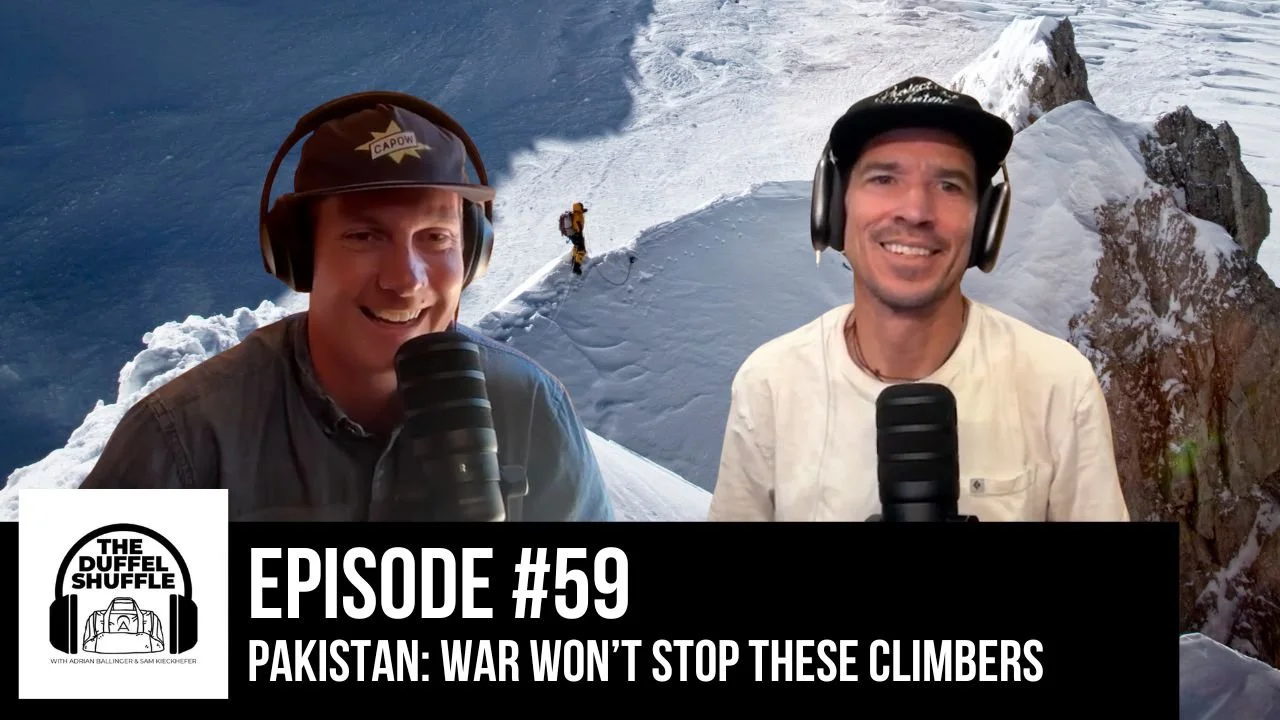
Episode 59: Pakistan Coverage - War won't stop these climbers
Sam and Adrian open episode 59 with three news stories — a bolting controversy resolved (kind of?) on Snake Dike, the public comment window on the PARC Act's draft management plans, and freeride skiing's addition to the 2030 Olympics — before shifting into a full rundown of the Pakistan 8,000-meter season, now underway.
Following spring season in the Himalaya, climbers and skiers move on to the Karakoram range, with the season often starting in June and peaking in July before temps warm too much into August.
Why Pakistan Climbs in Summer Nepal and Tibet's Himalayan season runs spring and fall because their more southern latitude brings a powerful summer monsoon that makes climbing impossible — and increasingly, makes even the shoulder seasons too warm for features like the Khumbu Icefall to hold together. Pakistan's Karakoram sits further north and west, giving it a weather pattern closer to Europe or North America, with a summer window instead. That window is compressing too: teams are now pushing to finish by mid-July rather than mid-August as glaciers destabilize earlier each year.
Nanga Parbat: A Season Already Winding Down — Except One Face Of Pakistan's five 8,000-meter peaks, Nanga Parbat climbs earliest, partly because it sits further south and is technically part of the Himalayan range rather than the Karakoram. The normal Diamir Face route is already falling out of condition. Meanwhile, a team is still attempting a new route on the Rupal Face — the mountain's massive alpine wall, home to some of the biggest lines in the world — in a pure alpine style (no camps, no fixed ropes, no pre-carrying gear).
A Quieter Pakistan Season: War and Infrastructure This year's season is noticeably smaller. Sam and Adrian point to the ongoing conflict along the Pakistan-Afghanistan border, which escalated sharply in February and forced expedition companies — including Alpenglow, along with Furtenbach Adventures and Madison Mountaineering — to sit the season out on safety and logistics grounds, while some Nepali operators chose to run smaller trips anyway. Beyond the war, Adrian frames Pakistan as roughly 20 years behind Nepal on tourism infrastructure: more avalanche exposure on routes like Broad Peak, and far less-developed logistics, hygiene, and food quality at base camp. He argues that gap will close, and that the Baltoro trek and Pakistan's climbing and skiing terrain — bigger, steeper, and less crowded than Nepal's — are worth experiencing before it does.
Andrzej Bargiel's Continuous Ski Descent of Nanga Parbat Andrzej Bargiel completed the first continuous ski descent of Nanga Parbat, skiing from summit to snowline without a break — distinct from the mountain's first-ever ski descent (Hans Kammerlander, 1990s) and last year's Rupal Face descent, both of which included overnight stops partway down. Bargiel used drone-guided route-finding to link a new line through the Diamir Face's serac zones, avoiding a rocky section that has forced other skiers to remove their skis. The descent makes Nanga Parbat his eighth of fourteen 8,000-meter peaks skied without supplemental oxygen, putting him on pace toward being the first to ski all fourteen in that style.
Remembering Guillaume "Gee" Pierrel A brief check-in following the loss of ski mountaineer Gee Pierrel on K6 a couple episodes back — his teammates are down safely, though no further details on the incident have been released.
More From the Karakoram Playground A team of Italian climbers put up a new 30-plus-pitch mixed route on K7 without summiting, which Sam and Adrian frame as a legitimate new-route achievement independent of a summit push. More broadly, they note this year's smaller, less commercial Pakistan season is producing an outsized share of no-oxygen and new-route climbing — with K2's fixed ropes up to Camp 2, and Broad Peak and the Gasherbrums positioning for summit pushes as climbers stack peaks ahead of K2's mid-to-late July window.
Follow along on Instagram @duffelshufflepodcast and visit www.duffelshufflepodcast.com to join our mailing list.
The Duffel Shuffle Podcast is supported by Alpenglow Expeditions, an internationally renowned mountain guide service based in Lake Tahoe, California. Visit www.alpenglowexpeditions.com or follow @alpenglowexpeditions on Instagram.