
Listen Here.
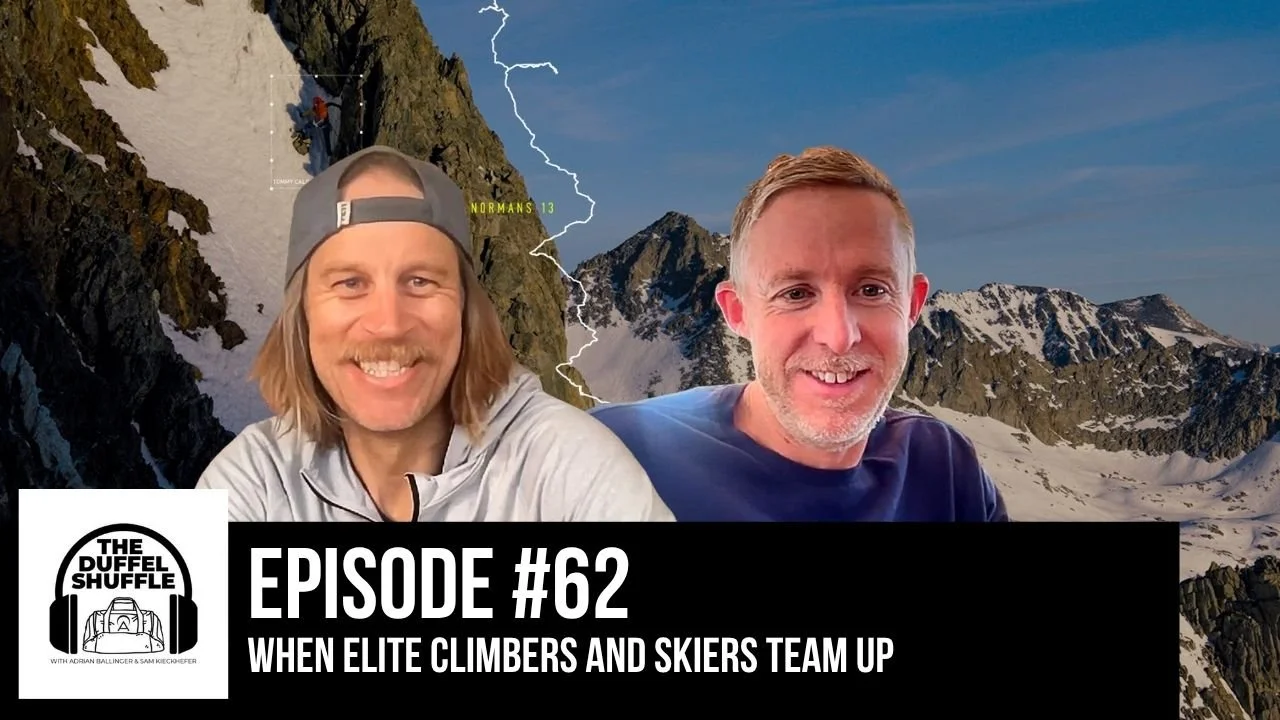
Cody Townsend and Tommy Caldwell: When Elite Climbers and Skiers Team Up
Episode 62 opens with quick hits on T-Mobile's satellite phone service and a run of Alps headlines — climbers requesting paid rescue after ignoring a Mont Blanc closure, a family of 36 rescued in the Austrian high country, and Kilian Jornet's viral post on the range's fast-changing climate — before Sam and Adrian sit down with Cody Townsend and Tommy Caldwell to talk through their spring traverse of Norman's 13.
Norman's 13 links the Sierra's thirteen 14,000-foot peaks from Mt. Langley to North Palisade, a route of over 100 miles and 40,000 vertical feet that had never been done in winter.
Townsend, a self-described "5.9 climber and 5.14 skier," recruited Caldwell — the inverse — after cold-emailing him with the idea; a day of simul-climbing at Lover's Leap and some recon skiing on Mt. Sill convinced them their risk tolerances matched well enough to commit.
Traveling south to north over eight days with cameraman Bjarne Salén, they broke the route into three distinct stretches: a technical run through the Whitney-area peaks, a 50-mile bushwhack and river-forge through John Muir Trail sequoia groves, and a final rope-and-crampons push across the notoriously exposed Palisades Traverse.
The trip nearly broke both of them. Townsend fought a lung infection and food poisoning through the early days, and a 25-hour closing push through isothermic snow — on a catastrophically failed ski boot — tested everyone's limits.
The two talk candidly about reading the line between suffering and real danger, the odd role reversal of a rock climber staying calm on exposed skiing while a skier plunge-steps nervously on rock, and how the trip changed the way Townsend plans traverses going forward.
A film on the expedition, shot largely on iPhone after their camera batteries mysteriously died, is due out this fall.
Follow our podcast on Instagram @duffelshufflepodcast where you can learn more about us and our guests. Visit our website at www.duffelshufflepodcast.com and join our mailing list.
The Duffel Shuffle Podcast is supported by Alpenglow Expeditions, an internationally renowned mountain guide service based in Lake Tahoe, California. Visit https://alpenglowexpeditions.com/ or follow @alpenglowexpeditions on Instagram to learn more.
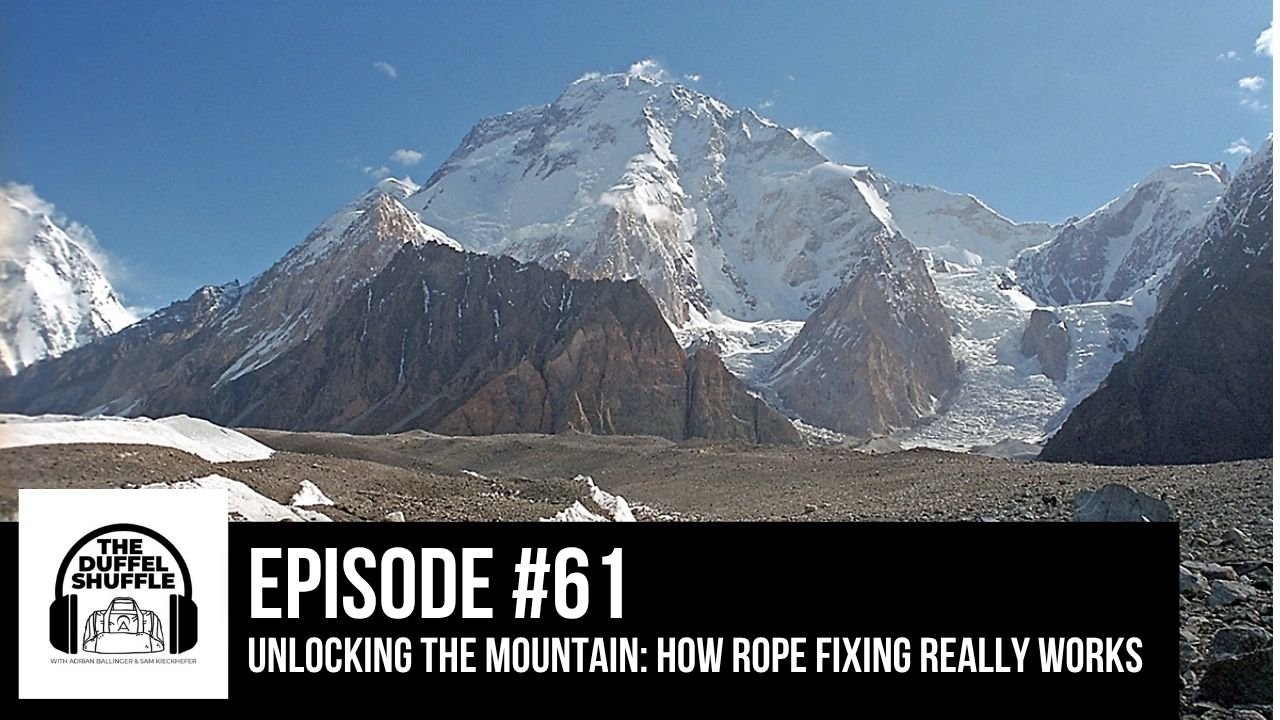
Episode 61: Unlocking the Mountain: How Rope Fixing Really Works
Episode 61 opens with a somber update on the Broad Peak avalanche in Pakistan that killed all ten climbers, including members of Nims Purja's team, on their July 30th summit push.
Following the update, Sam and Adrian dig into the episode's real focus: rope fixing, the process that makes the world's biggest mountains climbable.
Adrian breaks down the difference between alpine style — climbing a mountain in one unsupported push — and siege style, where teams fix rope from camp to camp so climbers can self-belay on the way up and move quickly on the way down. The practice exploded in scale after the 1996 Everest tragedy, when climbers caught in a whiteout couldn't find their way back to tents just yards away; today, nearly the entire route on Everest, and increasingly all 14 eight-thousanders, is strung with fixed line.
He traces how the work gets organized — from the old days of rival companies pooling gear and Sherpa labor, or tossing cash into a pot at Base Camp, to today's more formal systems: China's government-run team on Everest's north side, Nepal's Expedition Operators Association contracting the job out to local companies, and this season's milestone in Pakistan, where an all-Pakistani crew led by Mirzer Ali fixed a new line up Broad Peak's headwall — the first time a major Karakoram peak has been rope-fixed entirely by Pakistani high-altitude workers.
Adrian shares his own path into the work, from tunneling through a collapsing cornice on Ama Dablam in the early 2000s to a 2010 rope-fixing day on Everest so calm and untracked he calls it the highlight of his life. He's candid about the risks too: anchors that melt or rip out, old abandoned ropes that fail under body weight, and the 2010 K2 tragedy that killed nine climbers after a serac collapse wiped out the fixed line and left survivors without the gear or skills to downclimb.
His takeaway: fixed lines are an extraordinary safety tool, but never one to fully rely on without a backup plan.
Follow our podcast on Instagram @duffelshufflepodcast where you can learn more about us and our guests. Visit our website at www.duffelshufflepodcast.com and join our mailing list.
The Duffel Shuffle Podcast is supported by Alpenglow Expeditions, an internationally renowned mountain guide service based in Lake Tahoe, California. Visit https://alpenglowexpeditions.com/ or follow @alpenglowexpeditions on Instagram to learn more
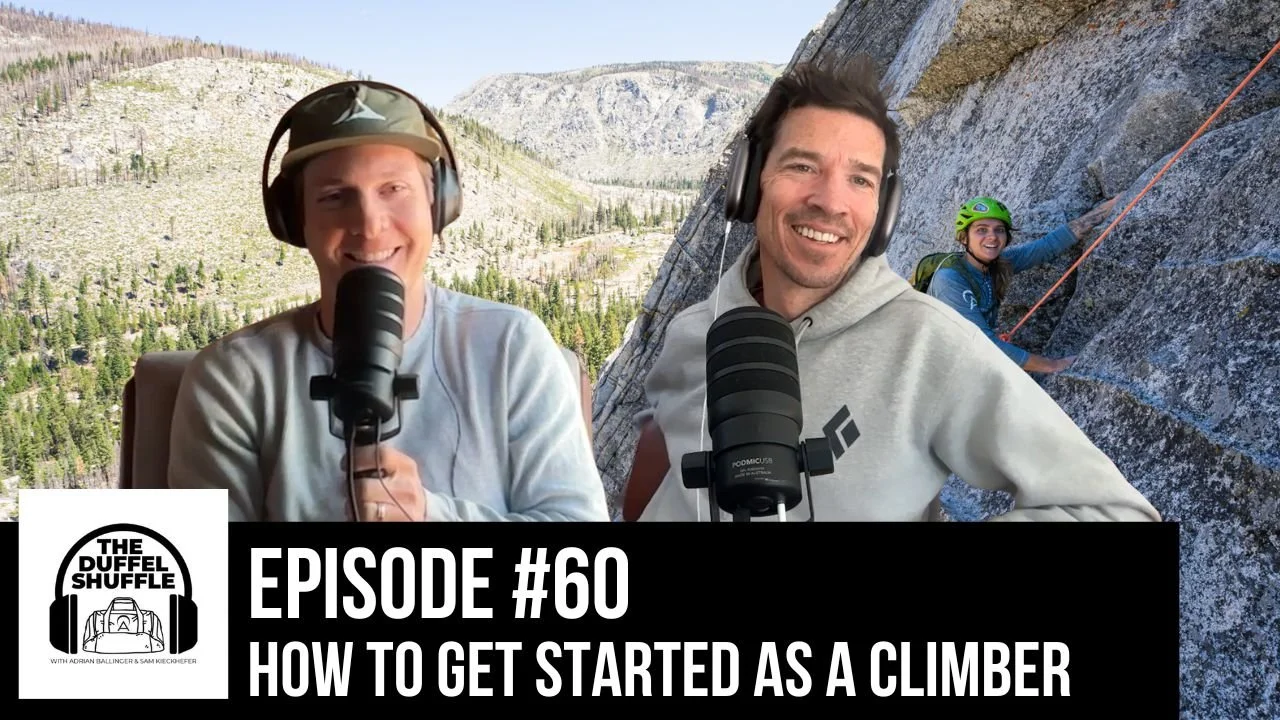
Episode 60: How to Get Started as a Climber
More than two years and sixty straight episodes for the Duffel Shuffle! Adrian calls in from a Nicaragua surf trip, and before getting into it, he and Sam touch on a rough week of accidents on classic trade routes (Mont Blanc, Huascarán, Rainier) and the FAA's new approval of drones for avalanche mitigation.
The real focus of the episode is a full roadmap for getting into climbing and mountaineering — for total beginners and for rock climbers eyeing high-altitude objectives alike. Adrian traces his own path in from age 12 on local Massachusetts crags through a college outdoor program that eventually got him to Ecuador at 17, and makes the case that adults break into the sport just as often as kids do.
Sam and Adrian lay out where to actually build the skills: climbing gyms, guide companies, and clubs for the technical basics (ropes, knots, belaying, crampon work);
via ferrata's and plain time on trails for the underrated skill of moving efficiently on uneven, exposed terrain; and a progression from guided client to genuine climbing partner, built through repeat trips with the same guide or company.
And risk — how hazard and consequence combine, why mismatched risk tolerance between partners causes the most friction in the mountains, and why so much of a guide's training is really about risk management rather than technical skill.
Parting advice: don't overthink the big goal, find your first one, and give it a few real tries before deciding it's not for you.
Follow our podcast on Instagram @duffelshufflepodcast where you can learn more about us and our guests. Visit our website at www.duffelshufflepodcast.com and join our mailing list.
The Duffel Shuffle Podcast is supported by Alpenglow Expeditions, an internationally renowned mountain guide service based in Lake Tahoe, California. Visit www.alpenglowexpeditions.com or follow @alpenglowexpeditions on Instagram to learn more.
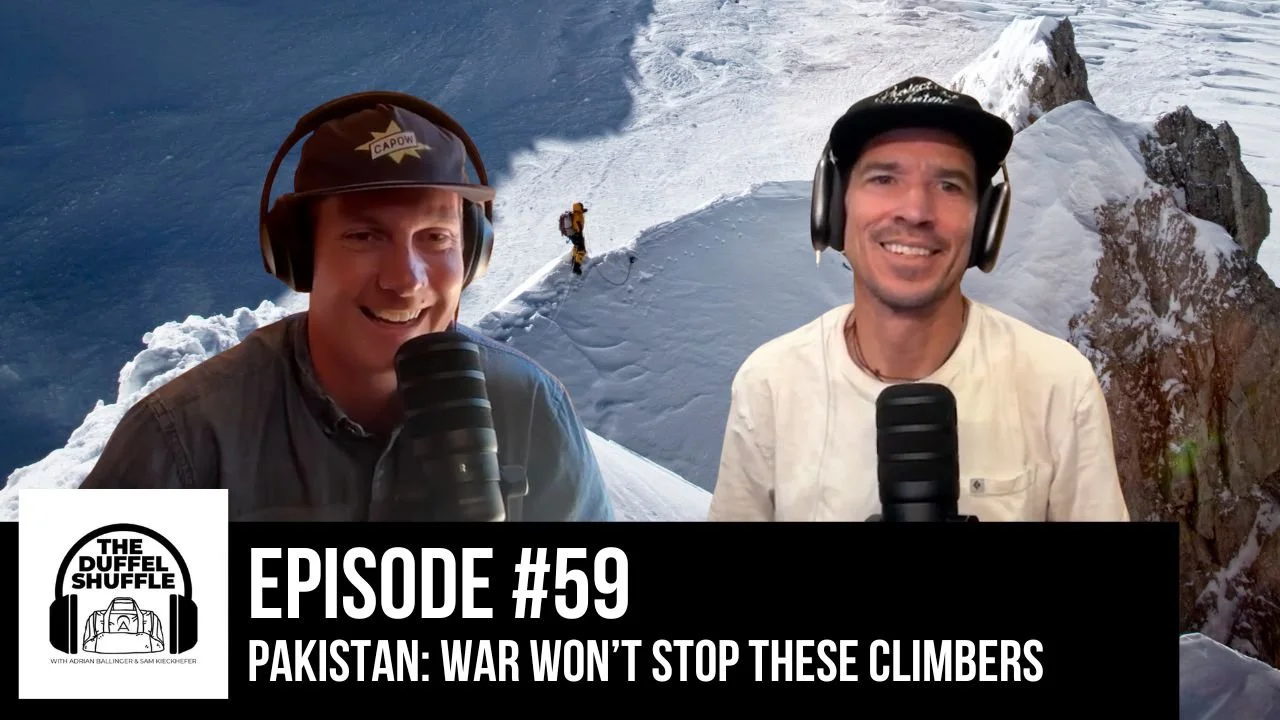
Episode 59: Pakistan Coverage - War won't stop these climbers
Sam and Adrian open episode 59 with three news stories — a bolting controversy resolved (kind of?) on Snake Dike, the public comment window on the PARC Act's draft management plans, and freeride skiing's addition to the 2030 Olympics — before shifting into a full rundown of the Pakistan 8,000-meter season, now underway.
Following spring season in the Himalaya, climbers and skiers move on to the Karakoram range, with the season often starting in June and peaking in July before temps warm too much into August.
Why Pakistan Climbs in Summer Nepal and Tibet's Himalayan season runs spring and fall because their more southern latitude brings a powerful summer monsoon that makes climbing impossible — and increasingly, makes even the shoulder seasons too warm for features like the Khumbu Icefall to hold together. Pakistan's Karakoram sits further north and west, giving it a weather pattern closer to Europe or North America, with a summer window instead. That window is compressing too: teams are now pushing to finish by mid-July rather than mid-August as glaciers destabilize earlier each year.
Nanga Parbat: A Season Already Winding Down — Except One Face Of Pakistan's five 8,000-meter peaks, Nanga Parbat climbs earliest, partly because it sits further south and is technically part of the Himalayan range rather than the Karakoram. The normal Diamir Face route is already falling out of condition. Meanwhile, a team is still attempting a new route on the Rupal Face — the mountain's massive alpine wall, home to some of the biggest lines in the world — in a pure alpine style (no camps, no fixed ropes, no pre-carrying gear).
A Quieter Pakistan Season: War and Infrastructure This year's season is noticeably smaller. Sam and Adrian point to the ongoing conflict along the Pakistan-Afghanistan border, which escalated sharply in February and forced expedition companies — including Alpenglow, along with Furtenbach Adventures and Madison Mountaineering — to sit the season out on safety and logistics grounds, while some Nepali operators chose to run smaller trips anyway. Beyond the war, Adrian frames Pakistan as roughly 20 years behind Nepal on tourism infrastructure: more avalanche exposure on routes like Broad Peak, and far less-developed logistics, hygiene, and food quality at base camp. He argues that gap will close, and that the Baltoro trek and Pakistan's climbing and skiing terrain — bigger, steeper, and less crowded than Nepal's — are worth experiencing before it does.
Andrzej Bargiel's Continuous Ski Descent of Nanga Parbat Andrzej Bargiel completed the first continuous ski descent of Nanga Parbat, skiing from summit to snowline without a break — distinct from the mountain's first-ever ski descent (Hans Kammerlander, 1990s) and last year's Rupal Face descent, both of which included overnight stops partway down. Bargiel used drone-guided route-finding to link a new line through the Diamir Face's serac zones, avoiding a rocky section that has forced other skiers to remove their skis. The descent makes Nanga Parbat his eighth of fourteen 8,000-meter peaks skied without supplemental oxygen, putting him on pace toward being the first to ski all fourteen in that style.
Remembering Guillaume "Gee" Pierrel A brief check-in following the loss of ski mountaineer Gee Pierrel on K6 a couple episodes back — his teammates are down safely, though no further details on the incident have been released.
More From the Karakoram Playground A team of Italian climbers put up a new 30-plus-pitch mixed route on K7 without summiting, which Sam and Adrian frame as a legitimate new-route achievement independent of a summit push. More broadly, they note this year's smaller, less commercial Pakistan season is producing an outsized share of no-oxygen and new-route climbing — with K2's fixed ropes up to Camp 2, and Broad Peak and the Gasherbrums positioning for summit pushes as climbers stack peaks ahead of K2's mid-to-late July window.
Follow along on Instagram @duffelshufflepodcast and visit www.duffelshufflepodcast.com to join our mailing list.
The Duffel Shuffle Podcast is supported by Alpenglow Expeditions, an internationally renowned mountain guide service based in Lake Tahoe, California. Visit www.alpenglowexpeditions.com or follow @alpenglowexpeditions on Instagram.

Episode 37 with Amie Engerbretson: An Indirect Path to Professional Skiing
Sam and Adrian are joined on Episode 37 by Amie Engerbretson, a Tahoe local who shares her non-traditional path to becoming a professional skier. One could say being a skier is in Amie's blood, or you could argue that the career found her, but nonetheless, Amie has been a staple in magazine's and movies for more than a decade.
Amie was born and raised in Tahoe, and as the daughter of a professional skier, she was surrounded by the industry from the very start. As Amie grew up, she pursued dance and ballet, and went off to college to study film. But the mountains called her back and before she knew it she was on magazine covers and in ski films.
- Amie talks about a film she directed, and starred in, a couple years back. The Hypocrite highlights the intersection between her work as a professional skier and her advocacy work with Protect Our Winters.
- With more than a dozen trips to ski in South America in the late summer, Amie shares some of her experiences, and the realities of skiing in the Southern Hemisphere.
- Amie shares all that she pursue's to make the professional skiing life work, from training insights to her work in activism and her recent foray into film production.
You can learn more about Amie on her website www.amieski.com, and follow her on Instagram @amieski.
Follow our podcast on Instagram @duffelshufflepodcast where you can learn more about us and our guests. Visit our website at www.duffelshufflepodcast.com and join our mailing list. The Duffel Shuffle Podcast is supported by Alpenglow Expeditions, an internationally renowned mountain guide service based in Lake Tahoe, California. Visit www.alpenglowexpeditions.com or follow @alpenglowexpeditions on Instagram to learn more.

Episode 15: Are You Ready to Climb To A Higher Altitude?
After discussing the three Piolets d'Or winners, and 60 finalists, Sam and Adrian jump into the complicated topic of high altitude climbing. The two share stories of their early experiences with altitude and talk about the basics of acclimatization and what a typical schedule might look at. Finally, they dive into the "aids" that are used for altitude climbing, from Diamox and Dexamethasone to Oxygen. A future episode will discuss the topic of Pre-Acclimatization using hypoxic tents, and what the Rapid Ascent system that Adrian has pioneered looks like.

Episode 14: So You Want to Be A Mountain Guide?
Adrian and Sam chat about what it means to be a mountain guide. From introducing the American Mountain Guides Association (AMGA) and International Federation of Mountain Guide Associations (IFMGA) to discussing the decades of guides who came before the AMGA path was the standard, this episode is a great starting point for those curious about the training and business side of the guiding industry.

Episode 12: Cody Townsend - 50 More Ski Lines?
Sam and Adrian sit down with Cody Townsend. The three discuss Cody's transition to the world of ski mountaineering, and his 50 Project which has taken the world of backcountry skiing by storm. With only 4 lines remaining, Cody discusses his progress and his attempts this past spring on University Peak and Mount St. Elias. Cody also shares his newest project, The 50 Plus, which will debut in October.

Episode 06: Jim Morrison - A Passion For Adventure
Professional Ski Mountaineer Jim Morrison joins Sam and Adrian for Episode 6.
The three talk about Jim's recent exploits in the Karakoram: a successful descent of the Great Trango Tower after he was unsuccessful the year prior.
Jim talks about enduring some of life's lowest lows and highest highs, and consistently coming back to the joy he experiences from any adventure, near or far.