
Listen Here.
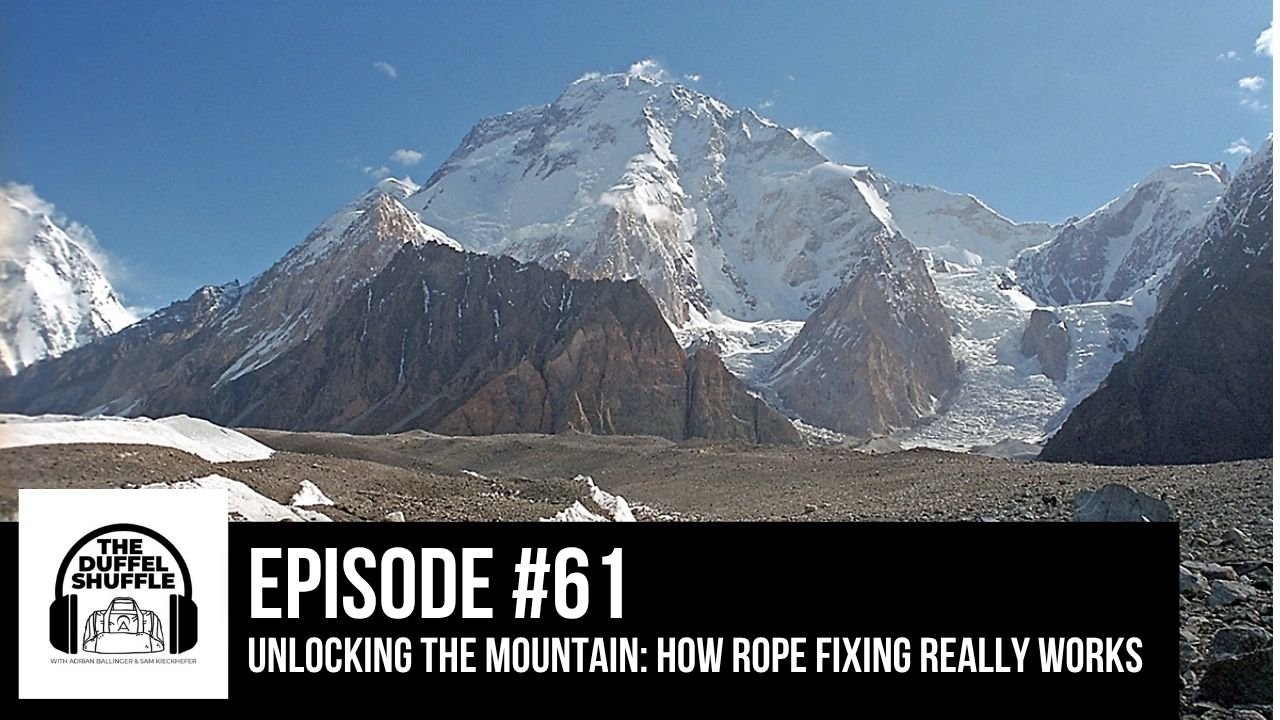
Episode 61: Unlocking the Mountain: How Rope Fixing Really Works
Episode 61 opens with a somber update on the Broad Peak avalanche in Pakistan that killed all ten climbers, including members of Nims Purja's team, on their July 30th summit push.
Following the update, Sam and Adrian dig into the episode's real focus: rope fixing, the process that makes the world's biggest mountains climbable.
Adrian breaks down the difference between alpine style — climbing a mountain in one unsupported push — and siege style, where teams fix rope from camp to camp so climbers can self-belay on the way up and move quickly on the way down. The practice exploded in scale after the 1996 Everest tragedy, when climbers caught in a whiteout couldn't find their way back to tents just yards away; today, nearly the entire route on Everest, and increasingly all 14 eight-thousanders, is strung with fixed line.
He traces how the work gets organized — from the old days of rival companies pooling gear and Sherpa labor, or tossing cash into a pot at Base Camp, to today's more formal systems: China's government-run team on Everest's north side, Nepal's Expedition Operators Association contracting the job out to local companies, and this season's milestone in Pakistan, where an all-Pakistani crew led by Mirzer Ali fixed a new line up Broad Peak's headwall — the first time a major Karakoram peak has been rope-fixed entirely by Pakistani high-altitude workers.
Adrian shares his own path into the work, from tunneling through a collapsing cornice on Ama Dablam in the early 2000s to a 2010 rope-fixing day on Everest so calm and untracked he calls it the highlight of his life. He's candid about the risks too: anchors that melt or rip out, old abandoned ropes that fail under body weight, and the 2010 K2 tragedy that killed nine climbers after a serac collapse wiped out the fixed line and left survivors without the gear or skills to downclimb.
His takeaway: fixed lines are an extraordinary safety tool, but never one to fully rely on without a backup plan.
Follow our podcast on Instagram @duffelshufflepodcast where you can learn more about us and our guests. Visit our website at www.duffelshufflepodcast.com and join our mailing list.
The Duffel Shuffle Podcast is supported by Alpenglow Expeditions, an internationally renowned mountain guide service based in Lake Tahoe, California. Visit https://alpenglowexpeditions.com/ or follow @alpenglowexpeditions on Instagram to learn more
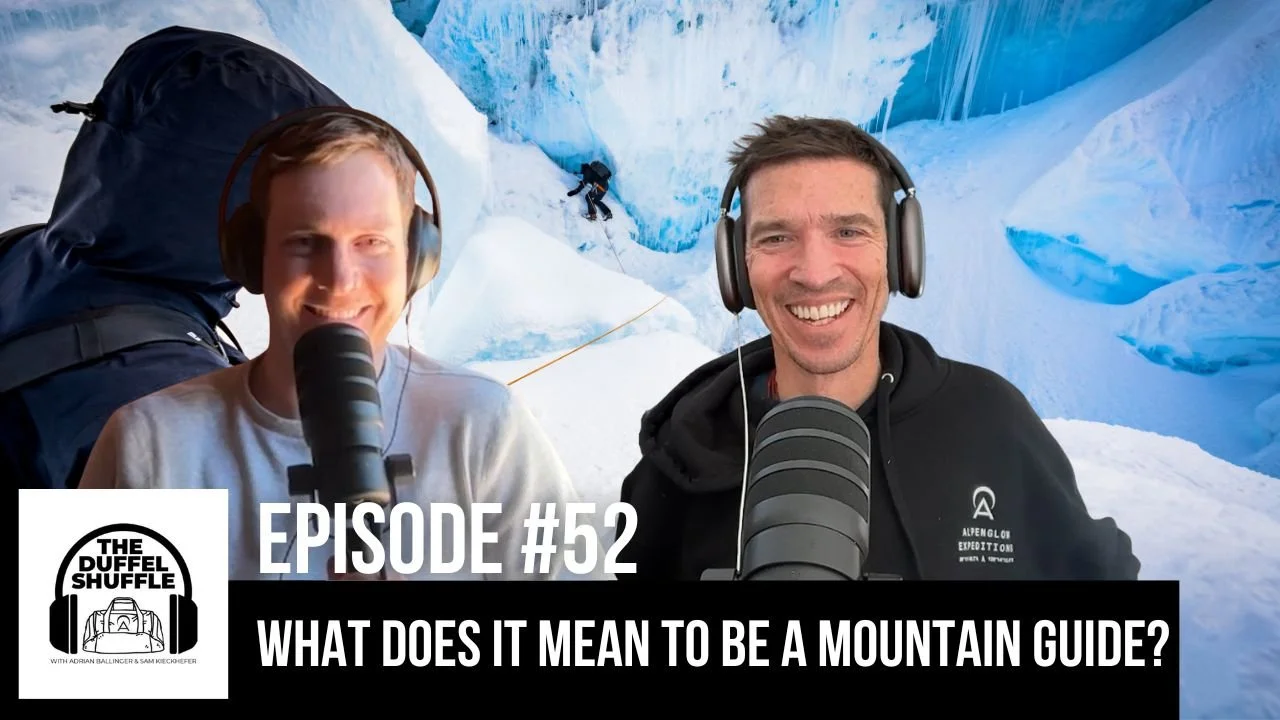
Episode 52: What does it mean to be a Mountain Guide?
With a string of high-profile guiding accidents making headlines this winter — including close to home here in Tahoe — Sam and Adrian sit down to dig into what it actually means to be a mountain guide, how guide companies are held accountable, and what you, as a consumer, should be looking for before you hire someone to take you into the mountains.
Before diving in, Adrian shares a personal update: a fractured back sustained in a sport climbing fall at Starwall that has him sidelined for the spring. Ever the risk management thinker, he unpacks the decision-making lapse that led to the accident and what the takeaway actually is. Sam, freshly back from a family ski trip to Davos, also weighs in on a developing fraud story out of Nepal in which rescue companies are alleged to have poisoned clients with baking soda to trigger fraudulent helicopter rescues — and why the distinction between mountain guides and high-altitude workers matters enormously in that conversation.
From there, Sam and Adrian turn to the main event: a wide-ranging conversation on guiding, certification, and accreditation.
What Is a Mountain Guide?: Why the term is so contested in the US versus Europe, and why the semantics actually matter for clients trying to evaluate who they're hiring.
Certification: How the AMGA certification and scope of practice system works, where Sam sits in that process, and why the gold standard is both certification and experience — not one without the other.
Accreditation: What AMGA accreditation means for guide companies, why only 32 businesses in the US have achieved it, and why Adrian believes it should become the industry standard — not the exception.
The Client's Role: Why the best guided experiences are partnerships, and why showing up as an active participant — not just a passenger — matters regardless of how qualified your guide is.
Follow our podcast on Instagram @duffelshufflepodcast where you can learn more about us and our guests. Visit our website at www.duffelshufflepodcast.com and join our mailing list. The Duffel Shuffle Podcast is supported by Alpenglow Expeditions, an internationally renowned mountain guide service based in Lake Tahoe, California. Visit www.alpenglowexpeditions.com or follow @alpenglowexpeditions on Instagram to learn more.